继承
定义类时若缺省extends 关键字,则所定义的类为java.lang.Object类的直接子类.
覆盖(overriding)
@Override 注解表示其后的方法必须是覆盖父类的一个方法。如果具有该注解的方法没有覆盖父类的方法,编译器将报告一个错误。
1
2
3
4
5
6
7
8
9
10
11
12
13
14
15
16
17
18
19
20
21
22
23
24
25
26
public class Base { public int pr_1; Base() {}; Base(int pr_1) {this .pr_1 = pr_1;} public void say () { System.out.println(pr_1 + "_from base" ); } } public class Derived extends Base { public int pr_1; Derived() {}; Derived(int pr_1) {this .pr_1 = pr_1;} @Override public void say () { System.out.println(pr_1 + "_from derived" ); } } public class Main { public static void main (String[] args) { Base b = new Base (1 ); Derived d = new Derived (2 ); d.say(); } }
super关键字
引用当前对象的父类对象.
this():调用本类中其他重载的构造函数(必须写在函数中的第一行)
this.XXX ():调用在本类中重写的父类方法super.XXX ():调用父类中的方法
1
2
3
4
5
6
7
8
9
10
11
12
13
14
15
16
17
18
19
20
21
22
23
24
25
26
27
28
29
30
31
32
33
34
35
36
37
38
39
40
41
42
43
public class Base { public int pr_1; Base() {}; Base(int pr_1) { this .pr_1 = pr_1; System.out.println("Base constructor" ); } public void say () { System.out.println(pr_1 + "_from base" ); } } public class Derived extends Base { public int pr_1; Derived() {}; Derived(int pr_1) { super (); super .pr_1 = 100 ; this .pr_1 = pr_1; System.out.println("Derived constructor" ); } @Override public void say () { System.out.println(pr_1 + "_from derived" ); } public void baseSay () { super .say(); } } public class Main { public static void main (String[] args) { Base b = new Base (1 ); Derived d = new Derived (2 ); d.baseSay(); } }
访问修饰符
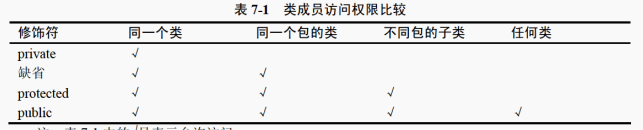
Java 类有 两种访问权限, public 和 缺省, public 权限可以供类外访问, 缺省只能包内访问.
类的成员有四种访问权限 private 缺省 protected public.
抽象类(abstract class)
抽象方法只有方法的声明,没有方法的实现。包含抽象方法的类必须定义为抽象类,定义抽象类需要的类前加上abstract修饰符。抽象类不能被实例化,即不能生成抽象类的对象。抽象类的非抽象子类必须实现父类的抽象方法.
1
2
3
4
5
6
7
8
9
10
11
12
13
14
15
16
17
18
19
20
21
22
23
public abstract class Person { public Person () {} public Person (int age, String name) { this .name = name; this .age = age;} public int age; public String name; public abstract void intro () ; } public class Programmer extends Person { public Programmer (String name, int age) { super (age, name);} public void intro () { System.out.println("I am a " + this .getClass().getSimpleName() + ", and my name is " + name + ", " + age + " years old." ); } } public class Main { public static void main (String[] args) { Programmer slacr = new Programmer ("slacr" , 19 ); slacr.intro(); } }
对象转换
子类对象和父类对象在一定条件下也可以相互转换,这种类型转换一般称为对象转换或造型 (casting)。对象转换也有自动转换和强制转换之分.
1
2
3
4
5
6
7
8
9
10
11
12
13
14
15
16
17
18
19
20
21
22
23
24
25
26
27
28
29
30
31
32
33
34
35
36
37
38
39
40
41
42
43
44
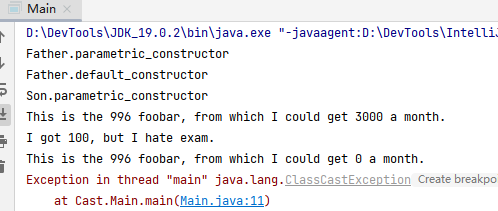
public class Father { public int salary; Father(int salary){ this .salary = salary; System.out.println("Father.parametric_constructor" ); } Father() { System.out.println("Father.default_constructor" ); this .salary = 0 ; } public void work () { System.out.println("This is the 996 foobar" + ", from which I could get " + salary + " a month." ); } } public class Son extends Father { public int score; public Son () { this .score = score; System.out.println("Son.default_constructor" ); } public Son (int score) { this .score = score; System.out.println("Son.parametric_constructor" ); }; public void doExam () { System.out.println("I got " + score + ", but I hate exam." ); } } public class Main { public static void main (String[] args) { Father f = new Father (3000 ); Son s = new Son (100 ); f.work(); s.doExam(); Father ff = s; ff.work(); Son ss = (Son)f; ss.doExam(); } }
instanceof 运算符
测试一个实例是否是某种类型的实例.
1
2
3
4
5
6
7
8
9
10
11
12
public static void main (String[] args) { Father f = new Father (3000 ); Son s = new Son (100 ); System.out.println( s instanceof Father ); System.out.println( f instanceof Father ); System.out.println(s instanceof Object); System.out.println(f instanceof Son); }
多态与动态绑定
多态 (polymorphism) 就是多种形式,是指Java 程序中一个类或多个类中可以定义多个同名方法,这多个同名方法完成的操作不同.编译时多态,是通过方法重载实现的。运行时多态,是通过方法覆盖实现的。
将方法调用与方法体关联起来称方法绑定 (binding)。若在程序执行前进行绑定,叫前期绑定.若在程序运行时根据对象的类型进行绑定,则称后期绑定或动态绑定。Java 中除static方法和 final方法外都是后期绑定.
对重载的方法,Java运行时系统根据传递给方法的参数个数和类型确定调用哪个方法,而对覆盖的方法,运行时系统根据实例类型决定调用哪个方法。对子类的一个实例,如果子类覆盖了父类的方法,运行时系统调用子类的方法,如果子类继承了父类的方法,则运行时系统调用父类的方法.
知识点
final 修饰的 class不能被继承, 其中的方法隐含为final修饰 ; final修饰的方法不能被重写; final修饰的变量不可更改.
参考
《Java程序设计(第3版)》 IBSN 9787302485520
Java API 文档